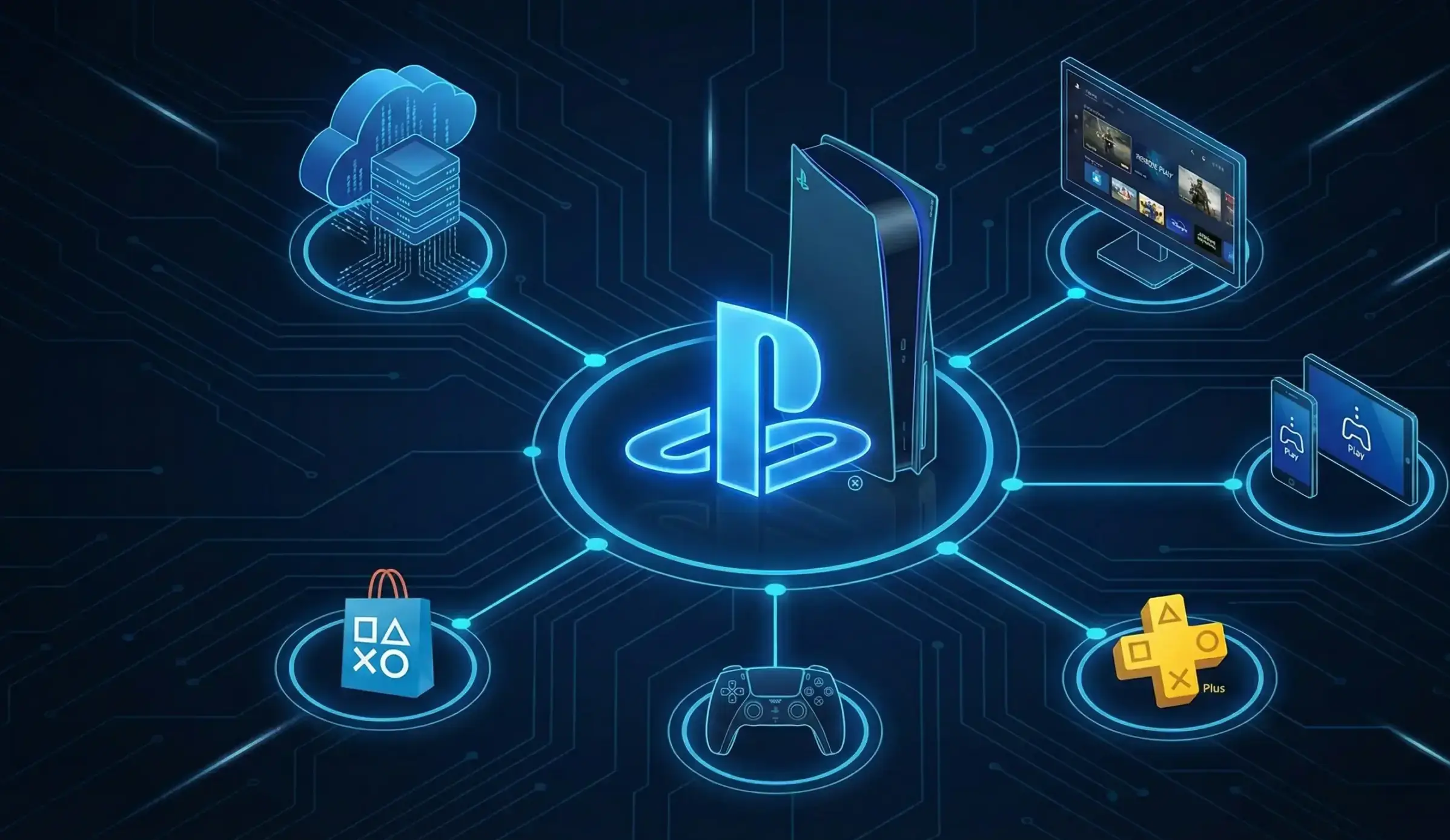
Sony spearheads the rapid transformations taking place in the global entertainment sector. The company’s long-term strategy centered on hardware development. Presently, however, the strategy employed by the Sony PlayStation Platform Business has shifted to viewing itself as an all-encompassing provider of digital ecosystems. The strategy has shifted from distributing plastic consoles to measuring the intensity of users’ engagement with the network. The Sony PlayStation Platform’s extensive hardware offerings have, in large part, supported the services and content provided.
Transforming the Business Model
The gaming industry has always been characterized by cyclical ‘boom and bust’ patterns. Console manufacturers, for instance, had to develop their consoles at a loss and offset their losses by selling physical copies of the games. Sony’s PlayStation business has completely transformed this model. We are currently living in an era of the “Engagement Model”. Business success depends on achieving high Monthly Active Users (MAUs) and high Average Revenue Per User (ARPU). Such a model has the potential to stabilize the company’s workflow.
The PS4 marked the beginning of a significant transformation for the PS business. With the PS5, Sony’s transformation has accelerated. Sony also recognizes that scaling its business by relying on a single hardware platform to access the PlayStation ecosystem has limitations. As a result, Sony PlayStation’s platform business has strategically shifted toward building a “walled garden” with increasingly porous boundaries. Console remains the expensive, high-end anchor of the ecosystem, but it now extends beyond consoles to include PCs and mobile devices.
This is a positive shift for Sony, as it limits the risk and uncertainty associated with hardware life cycles. The focus has shifted toward their network services, particularly the PlayStation Network (PSN), which provides greater revenue certainty. It becomes less relevant to the business if a user makes a purchase on the platform, as the business has begun operating more like a subscription service. It provides investors with confidence that the PlayStation platform is viable in the long term.
Hardware: The Premium Gateway Strategy
While Sony has shifted its focus to digital services, its hardware still plays a crucial role at the core of its entire PlayStation strategy. In the current Sony PlayStation platform business, the PS5 functions as a gateway. It is a “premium entry point” to the high-value users segment. It is the most effective way to capture committed gamers. As of early 2026, the PS5 has reportedly sold more than 92 million units worldwide.
The PS5 has been successfully positioned as a gateway console, but the hardware business is now encountering other economic realities. In previous console generations, component costs declined over time, allowing Sony to lower prices to capture mass-market segments. Today, the opposite is true. The current global semiconductor shortage has driven up component costs, leading to higher prices due to inflationary pressures on manufacturing and shipping logistics. As a result of these realities, the Sony PlayStation platform business has been forced to alter its pricing strategy.
To mitigate hardware constraints, Sony has been introducing incremental updates. The PS5 Pro is a prime example of this new strategy, and other peripherals, such as the PlayStation VR2 and PlayStation Portal, further diversify its hardware strategy. The Portal device is instrumental in maintaining consumer engagement within the Sony PlayStation platform ecosystem, even when users are away from their TVs.
The Digital Empire: Network Services
The largest revenue stream is the PlayStation Network (PSN). It underpins the modern Sony PlayStation platform business. With 132 million monthly active users, PSN is one of the largest digital entertainment platforms. This segment earns revenue from three key contributors—first, the massive transition to digital software sales.
Sony avoids the logistical costs associated with the manufacture and distribution of physical discs. The digital download rate ranges from 75 to 80%. Games are most often purchased through the PlayStation Store, thereby allowing Sony to apply the standard 30% platform fee. The second is the increased proliferation of microtransactions and DLC. “Live Service” games, such as Fortnite and Call of Duty, dominate the prize pool.
Sony can earn revenue even from games that it does not own. The Sony PlayStation platform business collects a fee on each transaction. Every skin, every battle pass, and every currency pack sold. This “tax” on the digital economy also funds costly first-party development initiatives. It’s crucial for maintaining the business model and contributes to the digital economy.
First-Party Studios: Content as Differentiator
With nearly all gaming platforms providing access to third-party games, Sony differentiates itself by providing exclusive first-party titles. PlayStation Studios is Sony’s in-house development team, and they create the “blockbuster” titles that become the face of the studio. System-selling franchises, such as God of War, are pivotal to the exclusivity of Sony’s PlayStation platform business.
Sony and Microsoft have opposing strategies. While Xbox offers first-party titles on subscription services, Sony strongly defends the premium sales model for its greatest hits. Sony’s PlayStation platform business values these games. They also believe that high-quality single-player experiences are worth the full price, solidifying the protected value of their intellectual property.
However, market pressure is forcing Sony to adapt slowly. There is a significant need for live-service titles to accompany their single-player successes, and Sony has realized this. Helldivers 2 demonstrates that Sony can publish successful multiplayer titles; however, market volatility in this area is high, so caution is warranted. The Sony PlayStation platform business needs to be particularly careful in this regard.
Expansion Strategy: PC and Mobile
An aggressive and controversial change is required that extends beyondConsolensole. For many years, ‘Only on PlayStation’ meant just that. However, the Sony PlayStation Platform now operates in multiple ways. They have begun aggressive porting of their older games to PC. The type of game determines the approach taken.
For live-service games, simultaneous launches on PS5 and PC are the most effective approach, as they help maximize the multiplayer player base. On the other hand, for major single-player games with strong narratives, PC releases typically follow PS5 versions by a few years. Such a staggered approach to PC releases helps ensure that PS5s are sold, and the company can subsequently monetize its intellectual property on PC. The Sony PlayStation platform business effectively ‘double dips’ on its intellectual property.
Mobile gaming is, without question, the largest untapped market, and small mobile games have historically been a weakness for Sony. The current plan is twofold: licensing PlayStation mobile game IPs to mobile game development companies and slowly building a mobile development team. This allows Sony to develop games based on its mobile gaming IPs and potentially attract more console gamers.
Gaming in the Cloud and the Infrastructure Behind It
Microsoft’s cloud gaming platform was a huge risk, but one that has the potential to pay off significantly. Her competitors, such as Sony, have adopted a more conservative approach to streaming as a service. The PlayStation Cloud service is currently treated as a value-add for Premium subscribers. They do not consider it a substitute for PlayStation consoles. Still, they are not completely ignoring the technology, as evidenced by partnerships they have secured to prepare the infrastructure, which they will need if the market shifts toward streaming.
The ability to stream PS5 games to a variety of devices will likely retain more users, as it reduces friction associated with trying new games and ultimately increases the number of hours a user is engaged. It will also help Sony retain the users it needs for the PlayStation platform. Sony will also be able to reduce the hardware’s computational requirements in the future, as evidenced by the PS5 Pro, which will leverage more software and cloud assistance. They are also researching AI upscaling, which will reduce barriers to entry for new users. The Sony PlayStation platform business intends to widen its funnel.
Financial Status and Market Standing
Financially, the Game and Network Services segment is the most important. It is usually the greatest contributor to the Sony Group’s revenue. Over the past few fiscal years, revenue has frequently exceeded $ 30 billion. The stability of the Sony PlayStation platform is critical to business operations. It also enables the larger Sony Corporation to assume additional business risks.
However, the division also has huge financial problems. Operating margins are being squeezed due to skyrocketing development costs. The budget for AAA blockbusters is now over $ 300 million. This creates a significant risk that a title will result in a financial loss. The division is focusing on cost optimization to alleviate budget pressures. The division also relies heavily on digital sales to offset costs.
PlayStation remains the leader in premium console sales worldwide. The hyper-competitive market is for total user attention, not just other consoles. PlayStation is now a competitor to TikTok and Netflix. That is why there is a big focus on user engagement. The business has to win the attention battle.
Future Strategy
A new generation of Sony PlayStation consoles is anticipated for 2027/2028, with the PlayStation 6 expected to emphasize greater integration between local hardware capabilities and cloud computing. Additionally, further developments in cross-media synergy are expected to strengthen this integration.
The Last of Us TV show demonstrated successful cross-media synergy. The commercialization of gaming IP is powerful, as it increases console and game sales. Strong synergy ensures relevance. The cultural play of the Sony PlayStation console business remains of great importance.
Key Performance Indicators: PS4 vs. PS5 Era
Here is a comparison of how the Sony PlayStation platform business has evolved from the previous generation to the current one.
| Metric | PlayStation 4 Era (Peak) | PlayStation 5 Era (2026 Estimate) | Strategy Shift |
| Hardware Sales | 117 Million Units (Lifetime) | 92+ Million Units (Current) | Focus on premium pricing over volume. |
| Digital Sales Ratio | ~40-50% | ~75-80% | Aggressive push for digital ecosystem. |
| Subscription (PS Plus) | ~45 Million Subscribers | ~50 Million Subscribers | Tiered model (Extra/Premium) for higher ARPU. |
| Primary Revenue Driver | Hardware & Disc Sales | Network Services & Microtransactions | Moving from one-time sales to recurring revenue. |
| Exclusivity Model | Console Only | Console First, then PC/Mobile | Expanding reach beyond the “walled garden.” |
| Cloud Gaming Focus | Experimental (PS Now) | Integrated Value-Add (PS Plus Premium) | Using the cloud for retention and ease of access. |
FAQ’S
Q1: How many PlayStation 5 consoles were sold in 2026?
By the start of 2026, PS5 sales had exceeded 92 million, indicating strong demand.
Q2: What is the current main revenue source for the Sony PlayStation platform business?
The primary sources of revenue are network services (PlayStation Network) and digital content sales.
Q3: How many users access the PlayStation Network in a month?
The PlayStation Network reports that 132 million users access the service in a month.
Q4: Is Sony completely moving from Hardware to Cloud Gaming?
Cloud gaming is a value-added service, but it will always be secondary.
Q5: Why is Sony releasing games on PC for the PlayStation platform business?
Releasing games on PC allows Sony to reach a wider audience and enables it to profit from older titles.
Conclusion
The Sony PlayStation platform business has evolved into a highly sophisticated operation. It has moved away from reliance on hardware. It now has a far more diverse operation as a digital services behemoth. With a balanced mix of premium content and recurring subscription revenue, the platform is thriving and carefully expanding into the PC and mobile markets. The greatest asset will be the continued adaptability of the business model. It is no longer about the box under the TV. It is a far more ubiquitous digital identity for the gamer.
For More Updates
Visit Our Website