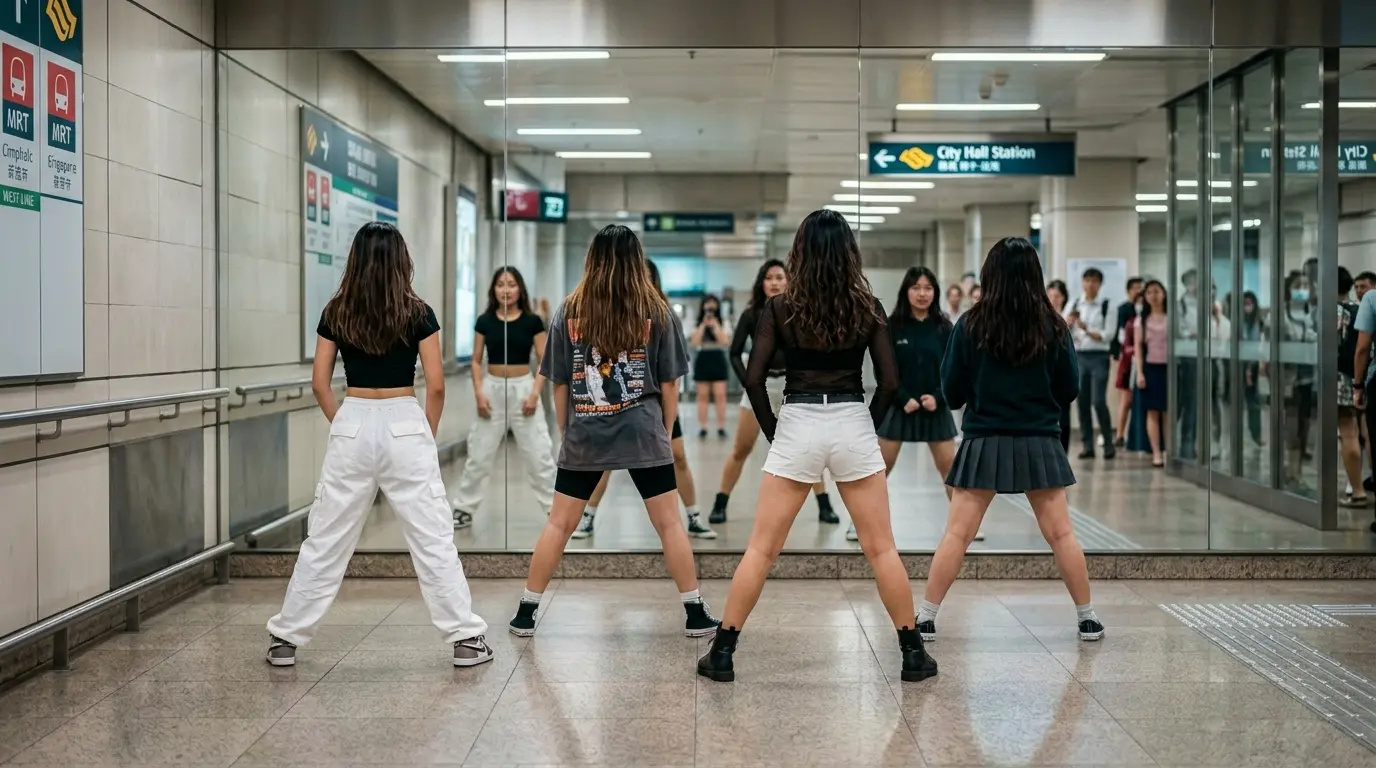
In the heart of Singapore, a simple underground walkway became an unexpected center for dance culture. Young dancers gathered daily to rehearse their routines, film videos, and connect with other performers. The passageway offered something rare in a crowded city: space, mirrors, and an audience of commuters passing by Singapore walkway dancers.
For years, the scene thrived. K-pop routines, hip-hop choreography, and freestyle dance sessions filled the corridor with music and energy. However, what started as a creative public space eventually drew complaints. Warnings from commuters prompted authorities to act, and the lively dance spot changed forever.
The Walkway That Became a Dance Studio
The underground passage linking Bayfront MRT Station with Gardens by the Bay became a popular practice spot for aspiring dancers.
Several features made the location ideal:
Large open space
Smooth floors are perfect for choreography
Floor-to-ceiling mirrors
Natural foot traffic provides an audience
These mirrors were originally installed by the nearby integrated resort Marina Bay Sands to improve the walkway’s visual appeal. However, dancers quickly found that the mirrors were perfect for practicing routines and recording dance videos in Singapore.
Soon, the area became a regular gathering spot for dance groups, especially young performers inspired by K-pop and social media trends, such as Singapore walkway dancers.
A Creative Community Forms
For many dancers, the walkway was more than just a practice space.
It became a community hub where dancers could:
Learn choreography from others
Share feedback and techniques
Film dance covers for social media
Meet fellow performers with similar interests
One dancer, Wilson Tay, mentioned that watching other dancers practice nearby was extremely motivating. Tourists sometimes stopped to watch and even join in, turning the space into a vibrant cultural moment, Singapore walkway dancers.
The atmosphere was energetic, spontaneous, and inspiring—something rare in a highly structured city like Singapore.
The Complaints Begin
Despite the creativity and excitement, not everyone appreciated the dancers.
The walkway serves as a busy route for commuters and tourists traveling between attractions. As the number of dancers grew, several issues arose:
Dance groups sometimes blocked the pathway
Tripods, speakers, and bags took up space
Commuters found it hard to pass during peak hours
Many residents and commuters complained that the dancers were obstructing pedestrian flow in an area mainly designed for walking.
Some people stated they didn’t mind the dancers, as long as they stayed to one side. But as crowds increased, the problem became harder to overlook.
Authorities Take Action
Eventually, management decided to take a straightforward but effective step.
They frosted the mirrors along the walkway, meaning dancers could no longer use them to practice.
When dancers returned on January 1, they found the mirrors covered.
This action effectively ended the walkway’s role as a dance practice location overnight.
Officials explained that the primary purpose of the passage was to enable safe, convenient pedestrian movement, not to serve as a rehearsal space.
A Debate Across Singapore
The decision quickly sparked debate throughout the country.
Critics of the decision argued:
The change was too harsh
The dancers were simply expressing creativity
Public spaces should allow artistic expression
Dance studios are very expensive for young people
Many Singaporeans felt that the dancers added life and culture to the area.
Supporters of the decision said:
The walkway was never intended for dancing
Pedestrian safety should come first
Some groups became inconsiderate and blocked the path
The controversy raised a larger question:
Who should control how public spaces are used?
Singapore’s Strict Urban Order
This issue reflects a broader aspect of Singapore.
The city is known for its organized urban planning and strict rules aimed at maintaining order, cleanliness, and efficiency. Public spaces are carefully managed, and many activities—like busking and street performances—require permits or designated areas for Singapore walkway dancers.
Singapore’s founding prime minister, Lee Kuan Yew, highlighted strong governance and planning as key to the country’s rapid development.
While this approach created one of the world’s most efficient cities, critics say it sometimes doesn’t allow for spontaneity or informal creativity.
A New Practice Space
After the controversy, some dancers moved to a quieter MRT station where mirrors were installed in a designated corner for practice.
Although the new space allows dancers to keep training, many believe it lacks the vibrant atmosphere of the original walkway.
Without crowds, music, and spontaneous interactions, it feels very different.
As dancer Wilson Tay explained, the new space is quieter and less exciting—but at least dancers can practice without interruptions.
The Bigger Question: Art vs Order
The debate over the Singapore walkway reflects an urban challenge faced everywhere.
Cities must balance:
Creative expression
Public safety
Efficient use of shared spaces
In many cities around the world, activities like street dancing, skateboarding, and busking become part of urban culture. But in a dense, tightly organized city like Singapore, even small disruptions can lead to significant issues.
The key challenge is finding a compromise that allows creativity to thrive without disrupting everyday life.
Conclusion
The story of Singapore’s dance walkway shows how quickly public spaces can change—and how fragile those transformations can be.
For a time, an ordinary passageway became a stage for creativity, friendship, and artistic passion. But once complaints arrived, the balance shifted back toward order and practicality.
While the dancers have found new locations, the debate continues:
Should cities focus on efficiency, or allow more room for spontaneous culture?
The answer may shape the future of urban life.