In today’s global economy, businesses operate in specialized markets. Companies no longer compete in a wide marketplace; instead, they work within specific industry segments that shape their operations, marketing, and customer interactions. These segments are called business vertical classification categories, and they are crucial for how organizations structure their strategies and find growth opportunities.
Business vertical classification categories help categorize companies based on the industries they serve or operate in. By organizing businesses into specific segments like healthcare, technology, finance, retail, or manufacturing, this system makes it easier to study markets and understand industry trends.
For instance, a software company that develops hospital management systems belongs to the healthcare vertical. In contrast, a company that builds online shopping platforms belongs to the retail or e-commerce vertical. Each vertical market has its own customers, regulations, operational challenges, and competitive landscape.
Understanding business vertical classification categories is essential for entrepreneurs, investors, marketers, and analysts, as it helps them identify patterns across industries. Companies that understand their vertical classification can create better marketing strategies, develop specialized products, and connect more effectively with their target audiences.
As industries evolve due to technology and globalization, vertical classification has become increasingly important. Companies that clearly define their industry vertical gain a competitive edge by focusing their efforts on the most relevant markets and opportunities.
This guide explores the meaning, importance, types, examples, benefits, and future trends of business vertical classification categories, helping companies see how industry segmentation shapes the global marketplace.
What Are Business Vertical Classification Categories?
Business vertical classification categories are the systematic grouping of companies by industry specialization or the markets they serve. A vertical market focuses on a particular industry or niche, allowing companies to tailor their products, services, and strategies to meet the needs of that sector.
Simply put, these categories group businesses with similar characteristics. Each category represents a distinct sector of the economy with its own customer base, technologies, and operational standards.
For example, the healthcare industry is a vertical category that contains hospitals, pharmaceutical companies, medical device manufacturers, and health technology startups. Similarly, the technology industry includes software developers, hardware makers, cybersecurity firms, and cloud service providers.
These vertical classifications help analysts and businesses understand how industries function and interact. They also make it easier to spot competitors, study market trends, and evaluate growth potential.
Another important aspect of business vertical classification is that it allows companies to focus on specialized expertise. Rather than offering generic solutions across all industries, businesses can design products tailored to the needs of a specific vertical market.
For instance, accounting software created for hospitals will differ significantly from software designed for retail stores. By focusing on a specific vertical, companies can deliver better value and create more relevant solutions.
Understanding the Concept of Vertical Markets
The idea of vertical markets is closely connected to business vertical classification categories. A vertical market refers to a group of businesses and customers that have common industry needs.
Industry specialization, rather than general functions, defines vertical markets. This means that products and services are designed specifically for one industry rather than multiple ones.
For example, a hospital management system is tailored for healthcare organizations. It includes features such as patient record management, medical billing, and appointment scheduling. These features cater to the healthcare vertical and would not suit industries like manufacturing or retail.
Similarly, software for construction companies may include project scheduling, cost estimation, and equipment tracking. These features address the construction industry’s specific needs.
Since vertical markets center on specialized industries, businesses in these markets often develop deep expertise in their field. This expertise helps them provide more effective solutions and build stronger relationships with their customers.
Difference Between Vertical and Horizontal Markets
To fully grasp business vertical classification categories, it is crucial to differentiate between vertical markets and horizontal markets.
A vertical market focuses on a specific industry. Products and services in this market are designed only for that industry’s needs. For example, healthcare software companies target hospitals and clinics, while retail management platforms focus on stores and online sellers.
In contrast, a horizontal market serves multiple industries with the same type of product or service. For instance, cloud storage services can be used by companies in healthcare, finance, education, and various other sectors.
Products like accounting software, project management tools, and communication platforms are common examples of horizontal solutions. These tools work across many industries without significant changes.
While horizontal markets focus on broad functionality, business vertical classification categories emphasize specialization. Businesses in vertical markets often offer more tailored solutions because they understand the challenges of a particular industry well.
Importance of Business Vertical Classification Categories
Business vertical classification categories are essential in modern business strategy. They help companies understand their position within the industry and develop targeted approaches to grow.
One major benefit of vertical classification is improved market analysis. When industries are organized into clear categories, analysts can evaluate market performance more effectively. This helps businesses identify trends, growth opportunities, and emerging technologies in specific sectors.
Another key benefit is targeted marketing. Marketing strategies differ significantly between industries. For instance, marketing healthcare services requires different messaging and regulations than marketing consumer electronics. By understanding their vertical category, companies can create marketing campaigns that resonate with their specific audience.
Product development is another area where business vertical classification categories offer great value. Companies focusing on a specific industry can design products that meet the unique needs of that sector. This leads to higher customer satisfaction and stronger competitive advantages.
Vertical classification also helps investors make informed decisions. Venture capital firms often specialize in certain industry verticals such as technology, biotechnology, or fintech. By concentrating on particular verticals, investors can better understand the risks and opportunities in those markets.
Lastly, vertical classification supports better competitive analysis. Companies can assess their performance against competitors in the same industry rather than against businesses in unrelated fields.
Major Business Vertical Classification Categories
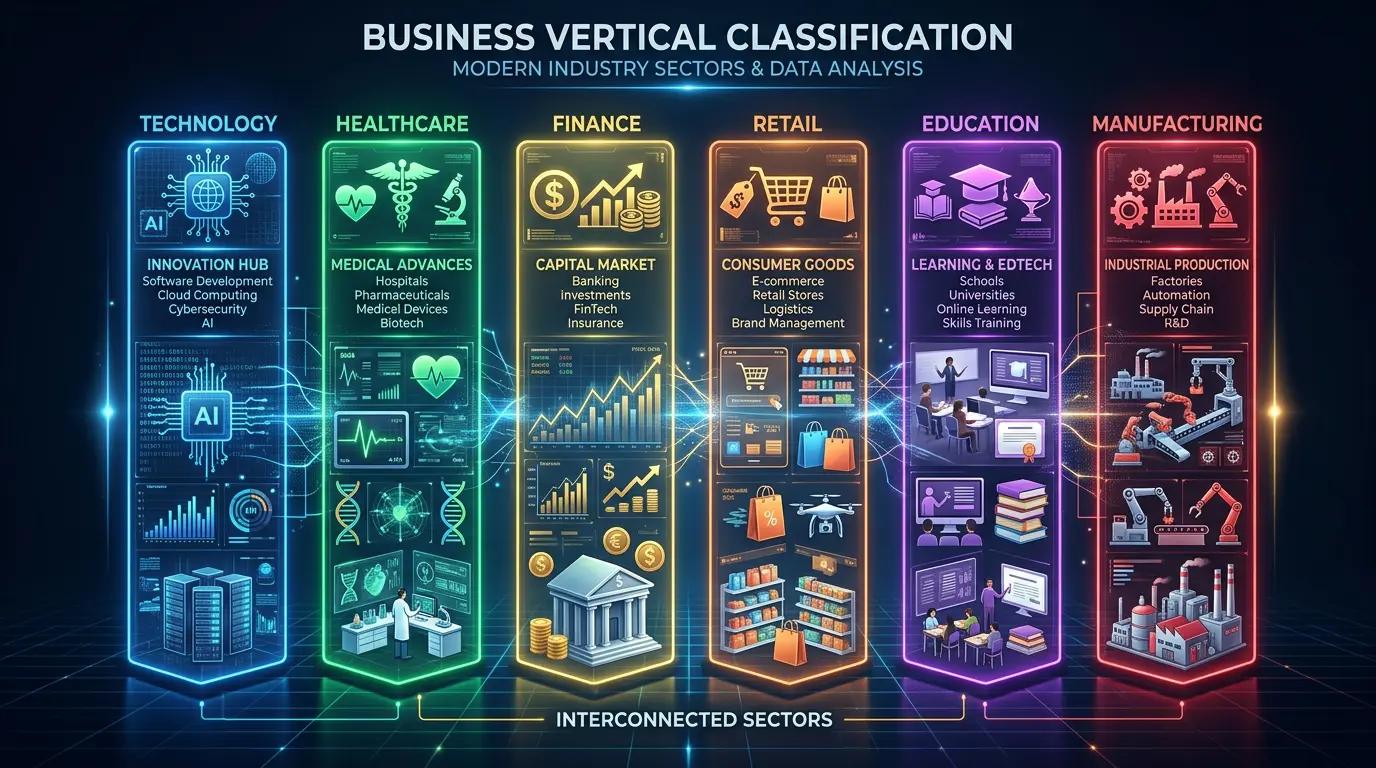
The global economy consists of various industry verticals. Some of the most significant business vertical classification categories include technology, healthcare, finance, retail, education, manufacturing, and media.
The technology industry is one of the fastest-growing verticals worldwide. It includes companies that develop software, hardware, artificial intelligence systems, and digital infrastructure. Technology businesses play a central role in digital change and innovation.
Healthcare is another critical vertical category. This sector comprises hospitals, pharmaceutical companies, medical equipment manufacturers, and health technology providers. Healthcare organizations focus on improving patient care and developing new treatments.
The financial services sector represents another key vertical category. Banks, insurance companies, investment firms, and fintech startups all operate within this space. Financial institutions provide essential services like banking, lending, and asset management.
Retail and e-commerce are also important verticals. Retail businesses sell goods directly to consumers through physical stores or online platforms. The rise of online shopping has significantly expanded the retail vertical.
Education is another major industry category. Universities, training organizations, and online learning platforms belong to this vertical. Digital education technologies have transformed how knowledge is shared around the world.
Manufacturing remains one of the largest vertical categories globally. Companies in this sector produce goods through industrial processes, which include automobiles, electronics, machinery, and textiles.
The media and entertainment sector represents another crucial vertical market. Film studios, streaming platforms, gaming companies, and publishing organizations operate within this industry.
Emerging Business Vertical Classification Categories
In addition to traditional industries, several emerging vertical markets are gaining importance in today’s economy.
Artificial intelligence is rapidly becoming its own industry category. AI companies create machine learning systems, automation tools, and advanced data analytics solutions.
Green energy is another fast-growing vertical market. Companies focusing on solar power, wind energy, and sustainable technologies are critical in the shift toward environmentally friendly energy systems.
Biotechnology is also emerging as a significant vertical category. Biotech firms concentrate on genetic research, pharmaceutical innovation, and medical technology development.
Space technology is another new vertical industry. Private companies engaged in satellite development, space exploration, and aerospace engineering are creating new opportunities in these areas.
These emerging industries show how business vertical classification categories continue to evolve as technology and innovation reshape the global economy.
Examples of Business Vertical Classification in Practice
Many companies implement vertical classification strategies to enhance their operations.
Software development companies often focus on a single vertical industry. For example, some specialize exclusively in healthcare software, while others create solutions for retail businesses or financial institutions.
Marketing agencies also apply vertical specialization. Some agencies focus on real estate marketing, while others target healthcare or e-commerce. This specialization enables agencies to deepen their expertise and deliver more effective marketing strategies.
Investment firms often organize their portfolios by industry categories. A venture capital firm might focus mainly on technology startups, while another could specialize in renewable energy companies.
These examples show how business vertical classification helps guide decision-making across various industries.
Benefits of Using Business Vertical Classification Categories
Businesses see many benefits from understanding and using vertical classification systems.
One major benefit is better customer targeting. When companies clearly define their vertical market, they can tailor their products and marketing messages to meet their customers’ specific needs.
Another advantage is increased industry knowledge. Companies that concentrate on a single vertical develop a deep understanding of that industry’s challenges, regulations, and opportunities.
Vertical classification also boosts partnerships and collaborations. Businesses in the same vertical often work together to create integrated solutions and expand their services.
Additionally, vertical specialization helps businesses stand out from their competitors. By focusing on a niche market, companies can offer unique solutions that generic providers cannot match.
Challenges of Vertical Classification
Despite its many advantages, vertical classification also poses some challenges.
Some companies operate across multiple industries, making it hard to categorize them within a single vertical. Large technology firms, for example, may provide services across healthcare, finance, retail, and education simultaneously.
Another challenge is the rapid evolution of industries. New technologies often blur the lines between traditional vertical markets. For instance, fintech merges financial services with technology, creating a hybrid vertical category.
Businesses must therefore stay flexible when using business vertical classification categories to ensure they accurately reflect changing market conditions.
Future Trends in Business Vertical Classification Categories
The future of vertical classification will likely be influenced by technological innovation and shifts in the global economy.
Digital transformation will continue to affect nearly every industry vertical. Businesses across sectors are adopting artificial intelligence, cloud computing, and data analytics to enhance their operations.
Collaboration across industries will also become more common. Companies from different vertical markets will increasingly work together to create integrated solutions.
Data-driven analysis will further improve industry classification systems. Advanced analytics tools will help businesses identify emerging vertical markets and track industry performance more accurately.
Finally, globalization will extend vertical markets beyond national borders. Businesses will increasingly operate within international industry ecosystems, creating new opportunities for growth and collaboration.
Conclusion
In today’s complex business environment, understanding business vertical classification categories is crucial for success. These categories offer a structured way to organize industries, evaluate markets, and develop targeted strategies.
By identifying their vertical market, businesses can emphasize specialized knowledge, create better products, and connect more effectively with their customers. Vertical classification also assists investors in evaluating opportunities and allows analysts to track industry trends more accurately.
As industries continue to evolve through technological changes and globalization, the significance of business vertical classification categories will only increase. Companies that clearly define their industry vertical and respond to changing market conditions will be better positioned to succeed in the competitive global economy.