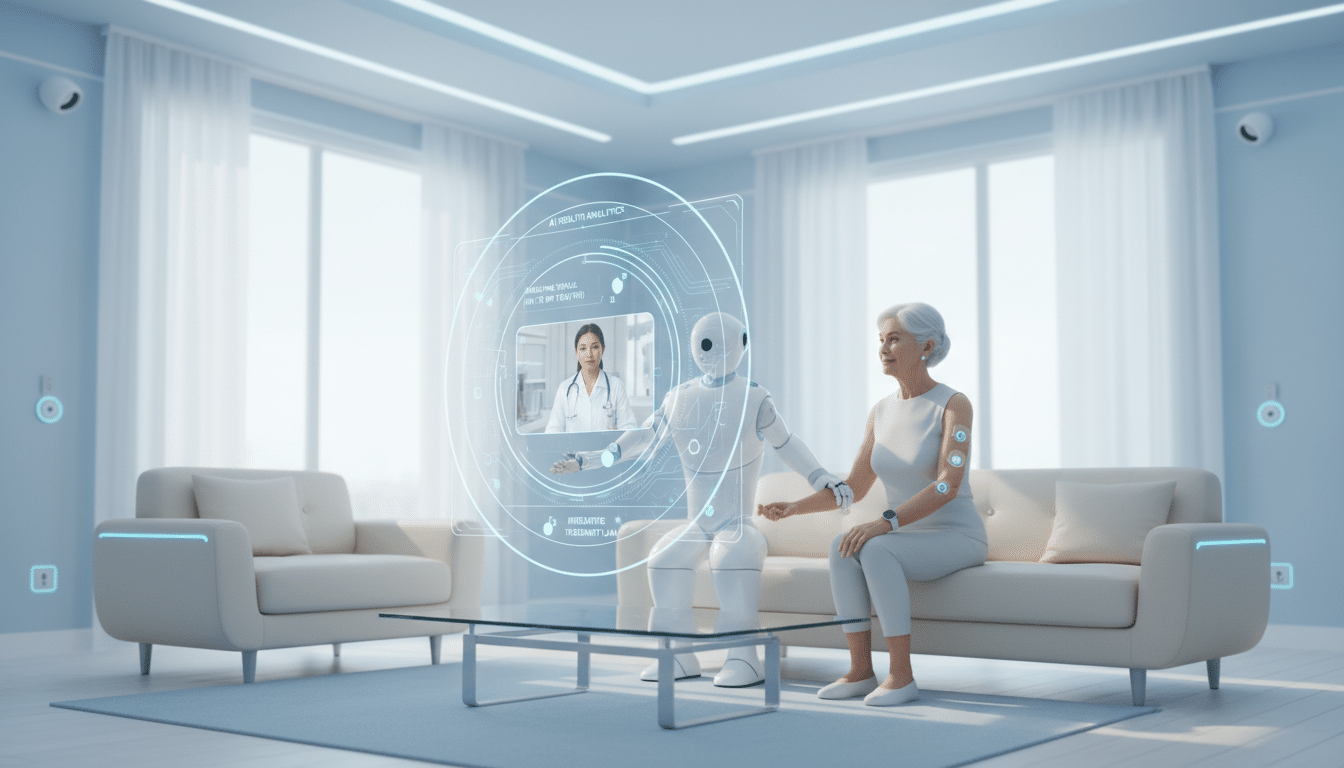
The digital era has helped transform and improve the clinical experience, seamlessly changing how patients receive services even without visiting a clinic. In this paper, we describe how future healthcare technology elevating at-home care assists in improving home care services and promotes a movement toward focused, personalized, evidence-based, and data-driven advanced medical care for diverse populations.
According to recent digital health adoption reports by the World Health Organization and Deloitte, emerging technologies like remote monitoring, AI, and telehealth make care more accessible. Furthermore, older adults, chronic patients, and those unable to visit clinics benefit the most. Additionally, clinicians can monitor patients remotely, improving outcomes while reducing in-person visits. Therefore, these digital tools demonstrate how future healthcare technology is elevating at-home care efficiently and inclusively.
The significant public and private investments in future healthcare technologies, centers the focus of such innovations in empowering the patients, and the safety and care of patients. The clinicians and digital health innovators are sharing the most positive impact and improvement of clinical outcomes, the innovations and technologies provided. In this paper, we focus how future healthcare technologies are improving home care services by innovation, accessibility, and proven practices.
Core Technologies Driving How Future Healthcare Technology Is Elevating At Home Care
| Technology | Role in Care | At‑Home Impact |
| Artificial Intelligence | Predictive analytics & diagnostics | More accurate remote assessments |
| Telemedicine | Secure virtual consultation | Eliminates geographic barriers |
| Wearable Devices | Real‑time biometric tracking | Early detection & intervention |
| Remote Monitoring | Continuous data transmission | Reduces hospital visits |
| Robotics | Assistance & mobility support | Enhances independence |
| Smart Home Systems | Environmental monitoring | Improves safety & comfort |
These key technologies combine clinical functionality with patient-centered design, demonstrating how future healthcare technologies are improving at home care.
Artificial Intelligence in Healthcare
The most important part of future healthcare technologies improvement regarding home care is artificial intelligence. Artificial Intelligence can see potential problems with a patients’ medical situation and send alerts to the appropriate care provider to intervene before it gets worse. AI assists with the personalization of care for patients by the way of predictive risk modeling and proven historical patterns. AI is proving to far exceed its predecessors as far as diagnostics and predictions while aiding with the automation of repetitive and mundane tasks. Patients also face the accolades of AI through fewer interventions, better communication, and remote consultations. As AI continues to develop, it reinforces the improvement of healthcare technologies, especially in the area of home care.
Virtual Consultations and Telemedicine
The use of telemedicine technologies represents the most current example of how future technologies for health care have the potential to improve home care. The use of telemedicine technologies provides a way to overcome distance, mobility, and scheduling related barriers to accessing care through the use of secure technology to connect providers and patients. Virtual care is beneficial to patients living in remote areas, elderly patients that have difficulty driving, and patients with chronic health conditions. Virtual care also allows for the integration of health care documents that helps with continuity of care and streamlines administrative processes.
Evidence supports that the adoption of telemedicine technologies increased during the most recent global health crises. This increased adoption demonstrates the flexibility and ability to adapt to a need. Health care systems that have adopted these technologies have improved patient compliance to care plans and have decreased the number of patients that miss scheduled appointments. Telemedicine services have had a significant impact on care delivery during global health emergencies. Telemedicine services have also demonstrated the substantial impact that computer technologies can have on health care services at home.
Wearable Health Devices and Personalized Monitoring
Wearable devices exemplify how home care technology is advancing in future healthcare by emphasizing continuous and proactive monitoring. Smartwatch and biosensor technologies, connected patches and smartphone applications monitor and report vitals, bugs such as heart rate, oxygen saturation, and sleep, and other relevant metrics. These devices notify both healthcare teams and patients of abnormal and foreboding conditions. Recorded information from wearables encourages preventive care and responsive adjustments to the personalization of care. This information is also instrumental in optimizing treatment, in addition to the care team’s ability to set targets for wellness and share pertinent information. In this manner, wearables alleviate the need for emergency medical episodes while decreasing the clinical burden.
Remote Patient Monitoring and Continuity of Care
A further enhancement of home healthcare technologies is illustrated by Remote Patient Monitoring (RPM) systems, which allow for real-time data collection and transmission of both biometrics and patient behavior. RPM systems enable chronically ill patients to receive clinical assistance without having to visit healthcare facilities. RPM systems report fewer readmissions and long-term management of patients with ongoing conditions. By providing real-time clinical observations, RPM systems improve patient safety by providing early clinical interventions for troubling clinical abnormalities. Active RPM systems improve the quality and quantity of clinical care provided to patients in their homes, and improve the patient-provider clinical dyad.
AI‑Driven Diagnostic Accuracy in At‑Home Care
| Condition | Traditional Accuracy | AI‑Assisted Accuracy |
| Diabetes Prediction | 78% | 94% |
| Heart Disease Detection | 82% | 96% |
| Cancer Screening | 75% | 93% |
| Respiratory Disorders | 80% | 95% |
Roughly healed concludes in RPM devices and modern AIs, i.e., early detection of primary healthcare problems and improving the accuracy of healthcare diagnostics.Robotics and Assisted Support
Robotics and Assisted Support
Robotics is a critical component of emerging technologies in the healthcare industry. Since the field is advancing, the emphasis on robotics in out-of-hospital care and assistance is increasing. Robotic caregivers provide services such as mobility assistance, medication scheduling, and task management. This service also allows the disabled to reclaim some independence. Many robotic systems now integrate with EML to provide customized care by taking and using notes on the preferences of the user.
This also serves the dual purpose of providing a prescriptive peer and lessening the load on a caregiver. This is especially applicable to seniors and patients with restricted functionality. Rehabilitation robotics also aids in the execution of and assistance with physical therapy and post-operative recovery. High contact robotics also increase the safety of a patient by decreasing the need to interact with their environment and by decreasing the patient’s risk of falls and the injuries associated with falling. This technology helps cultivate a sense of safety, empathy, and understanding in a patient’s home.
Integration of Environment and Smart Home Healthcare Systems
Smart home systems exemplify how future technology in healthcare is enhancing the home-care experience, automating safety, comfort, and monitoring functions throughout the home. Response systems, and voice and command sensors, detect falls and environmental dangers and respond to patients. Smart devices connected to healthcare dashboards allow data sharing. Recovery-centered environments can be created using automated systems for smart lighting and temperature control and security systems. Wearable devices and remote patient monitoring (RPM) systems integrated with smart home systems provide synchronized systems for health information. Real-time data access to healthcare providers allows for timely decision-making and improved healthcare outcomes. Smart environments provide safe and effective care in the home, and are thus an integral part of advanced healthcare technology.
Trends in the Growth and Adoption of Digital Healthcare
| Year | Market Value (USD Billion) | Growth Rate (%) |
| 2020 | 145 | 12 |
| 2022 | 210 | 15 |
| 2024 | 295 | 18 |
| 2026 (Projected) | 410 | 20 |
The above data illustrates the significant investment and adoption in future healthcare technology, and illustrates the strong impact it has on improving care in the home.
Economic Impact and Cost Efficiency
Future healthcare technology’s most important aspect regarding \ at home care \ is cost efficiency. With the use of remote monitoring, virtual visits, and predictive insights, there is a reduction of costly hospital stays and emergency services. Patients also reduce costs as there is no need for travelling, as well as time, and costs that would be associated with a clinic visit. Health care systems lose less money as there are streamlined administrative burdens, and there are less routine assessments that need to be done by clinical staff. Digital platforms improve resource utilisation by reducing the cost associated with treating the long-term effects of not addressing preventive care. Based on economic models, the most significant cost efficiencies in health care systems are created by increasing access to at-home care systems. Cost data also demonstrates the Healthcare technology of the future is placing improvements clinically and financially in healthcare systems.
Obstacles and Moral Implications
Despite advancements, adopting future healthcare technology for home care has many complex issues and challenges. Issues such as regulatory, compliance, data privacy, and cybersecurity, need strong governance frameworks. Gaps in technology and digital literacy within the older population may hinder the adoption and Digital divide in rural and underdeveloped areas may hinder the adoption and effective use of these technologies. Ethical concerns for the development of AI focus on reducing bias in the process and the decision-making process and ensuring fairness in the process. Joint development of digital governance frameworks and collaborative strategies of the public and private sectors will promote the development of AI technologies in home care services. Dealing with the basic issues will promote equitable development and use of AI technologies in home services.
Hospital vs At‑Home Care Comparison
| Aspect | Hospital Care | At‑Home Care |
| Cost | Higher | Lower |
| Accessibility | Limited by location | Available remotely |
| Monitoring | Intermittent | Continuous |
| Comfort | Clinical environment | Familiar home |
| Infection Risk | Higher | Reduced |
This comparative analysis demonstrates the impact of future healthcare technology on elevating at home care and reinforces the value of future healthcare technology and improves home care services by providing greater comfort, affordability, and monitoring centered on the patient.
Frequently Asked Questions
1. What technologies are driving at-home healthcare transformation?
Core examples for elevating care at home in the digital health era are artificial intelligence, telemedicine, and smart systems as well as wearables.
2. How does AI improve at-home healthcare?
AI improves at-home healthcare by providing continuous remote personalized treatment support, improved diagnostics, and predictive insight.
3. Are wearable devices clinically reliable?
Many wearable devices provide real-time data for care teams and patients, and as a result, more wearable devices are meeting the standards for clinical reliability.
4. What barriers affect digital home healthcare adoption?
Infrastructure gaps, data privacy, regulatory complexity, and low digital literacy are barriers to the adoption of digital health home care.
Conclusion
Advancements in digital health continue to highlight how healthcare technology will impact home care positively. Innovations in artificial intelligence, telemedicine, robotics, and smart home systems will drive positive change. These technologies will provide improvement in accessibility, personalization, and outcomes as physician workflows, patient expectations, and care models change. These advances will support positive change in care delivery through the reduction of costs and enhancement of safety. Positive change in the care delivery model will be driving focus on preventative health, which will shift care delivery to be outside of clinical settings. Ethical and consciously equitable implementation of future digital healthcare technology in home settings will be the result of collaboration of stakeholders, regulation, and evidence-based practice. The integration of technology in home care delivery will prioritize the advanced technology future of care that will be patient focused and connected.
More updates
For more updates about tours and travels, visit our website.